Why overthinking is not always the problem, and how to quiet the mental chatter when it is
As someone who has spent a significant chunk of her life overthinking things, I’ve often wondered whether it’s a blessing or a curse.
For years, I thought the answer was obvious. A curse.
But recently I’ve been wondering if I’ve been a bit unfair on my overthinking tendencies. Because overthinking isn’t all bad and it has really helped me when its needed to.
Its definitely helped me solve complex problems at work; overthinkers tend to be reflective. We notice things. We spot patterns. We’re often empathetic because we’ve spent so much time imagining how other people might feel.
“Not all thinking is the problem. The trouble starts when thinking stops being useful and starts going round in circles.”
When thinking helps
I have found it useful to ask myself a simple question: Is this thought helping me move forward? Thinking helps when it leads to action, learning or understanding. Some situations where I think its really been helpful are; Reflecting on a mistake and deciding what you’ll do differently next time. Weighing up the pros and cons of a decision. Planning something important. Learning from experience.
When thinking doesn’t help
The warning signs are usually replaying something that has already happened, predicting an outcome I cannot possibly know, looking for certainty where none exists, or having exactly the same thought for the tenth time that day. This can get really exhausting and if the thoughts in your head are zapping your energy but getting you nowhere, its time for a rest or some of the techniques below.
Something I’ve been trying
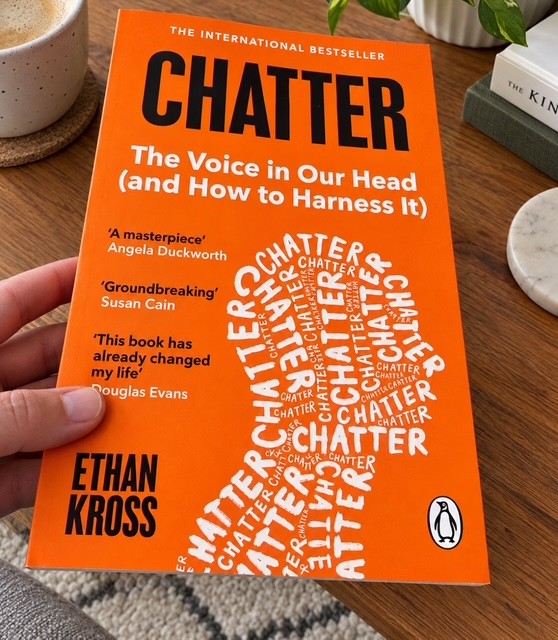
I’ve been reading this interesting book called ‘Chatter – The Voice in Our Head (and How to Harness It) by Ethan Kross. For the nerds amongst us, I loved reading the case studies and research done on people’s over thinking/rumination tendencies but also understanding why our brains are designed to look forwards and backwards, and not just be in the present moment all the time.
One idea from the book that I really like is self-distancing. Instead of talking to yourself as “I”, talk to yourself as if you were an observer of the situation, and speak to yourself in the third person so instead of I, add your name:
“What does Jen need right now?” or ‘Jen, take a breathe’
It sounds a bit weird but it works, and works much quicker than the ‘fly on the wall’ observer when trying to calm the brain or nervous system in the middle of a thinking loop.
Another thing that helps
When I notice my mind getting noisy, I ask myself: Do I need a solution, or do I need a break? Sometimes the brain needs less input, not more. I got myself so worked up in my head recently that I took a 3 hour nap instead (the luxury!) and my mind was clear when I woke up. We don’t always have that option, its rare many of us can just take a nap, but a short circuit breaker like a walk, distracting task, de-cluttering something can have a similar impact.
Final thoughts
I’ve stopped trying to become someone who never overthinks. What I’m trying to learn instead is the difference between useful thinking and unhelpful chatter. As with most things in life, the answer probably is not to think less. It’s to know when enough thinking has been done. I want to keep the curious, problem solving planner and let go of the looping over uncertainty and rumination. It is definitely a work in progress.


Leave a comment